
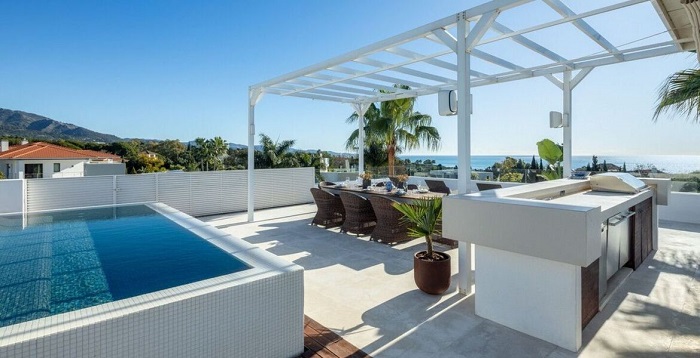
As property markets around the world grapple with weaker growth, elevated borrowing costs and geopolitical unease, Marbella continues to move in the opposite direction. On the Costa del Sol, the high-end residential sector is not merely holding up; it is advancing. Record pricing, constrained supply and sustained international demand have combined to make Marbella one of the clearest outliers in the post-pandemic real-estate landscape.
The figures point to continued strength
In the first half of 2025, Marbella’s luxury residential market did more than withstand the broader international slowdown; it outperformed the wider Spanish market. Several indicators stand out. Over the past seven years, the market has doubled in size. Transaction levels in the first six months of 2025 exceeded those seen in 2024. Demand remains particularly robust among buyers from the United Kingdom, Germany, the Netherlands and the Nordic countries. The overall picture is straightforward: while many residential markets are flat or retreating, Marbella is experiencing rising demand alongside increasing prices, largely because supply remains exceptionally tight.
A market that has not lost momentum
At a time when residential values in cities such as London and Los Angeles have begun to adjust, Marbella has continued to resist the cooling trend. Sales activity at the top end of the market, encompassing prime villas, penthouses and design-led apartments, remained on an upward path through 2024 and into 2025. Prices have not settled into a plateau. On the contrary, they have continued to climb, especially in ultra-prime locations including the Golden Mile, Sierra Blanca, Nueva Andalucía, La Zagaleta and Los Monteros.
Across the past decade, Marbella’s luxury property segment has expanded to more than twice its former size. Even during the first half of 2025, completed transactions exceeded the previous year’s total for the same period, reinforcing the area’s pattern of outperformance. The average selling period for premium homes has contracted sharply, and a notable number of properties now change hands before ever reaching the open market.
Why Marbella continues to outperform
Lifestyle remains the central driver
Marbella’s enduring strength rests first and foremost on its appeal as a place to live. Few destinations in Europe offer such a concentrated mix of Mediterranean weather, international accessibility, acclaimed gastronomy, golf, yachting and luxury hospitality. Buyers are not simply acquiring property; they are securing access to a particular way of life.
As remote and hybrid working models have become more common, the traditional notion of a second home has also changed. For many affluent buyers, Marbella now represents a dual-lifestyle residence: a home that can serve as a principal base for much of the year while still offering the atmosphere, climate and services associated with a resort destination. That combination has widened the market far beyond occasional holiday ownership.
A deeply international market
Marbella draws purchasers from across a broad global base. The buyer pool includes clients from the United Kingdom, Scandinavia, Germany, the Netherlands, Belgium, the Middle East and, increasingly, the United States. That breadth of demand gives the market a degree of protection against localised weakness.
Many of these international purchasers are either cash buyers or only lightly dependent on borrowing, which helps explain why higher interest rates have had limited influence on their ability to transact. Their decision-making is typically centred on lifestyle, discretion and the long-term value of owning property in Marbella rather than on the cost of finance.
A structural shortage of supply
The market’s resilience is also underpinned by a basic but powerful constraint: there are simply too few homes available, particularly in the prime and super-prime segments. Developable land is limited, and many of the most coveted districts are already fully established.
Along significant stretches of Marbella’s coastline and hillside, planning controls are designed to protect green areas, restrict density and preserve sea views. These rules help maintain the character and exclusivity of the town, but they also leave very little room for expansion. Developers therefore compete intensely for the small number of plots that come to market, pushing land prices higher and, in turn, increasing the final value of completed homes.
This scarcity is intensified by the behaviour of existing owners. Many hold property for lifestyle reasons rather than purely financial ones. Villas are often retained within families, and in a rising market there is limited incentive to sell. The consequence is unusually low turnover and a persistent shortage of stock.
The mindset of the Marbella buyer
Buyers at Marbella’s top end differ fundamentally from those operating in more conventional residential segments elsewhere. Their decisions are rarely driven by necessity or by access to finance. Instead, they are motivated by aspiration, preference and a long-term view. A seafront villa or penthouse with sweeping views is not merely a place to live; it functions simultaneously as a symbol of achievement, a private retreat and a store of value.
That mentality has particular relevance in a period of wider uncertainty. High-net-worth buyers are increasingly drawn to locations that combine quality of life with stability. Spain’s political framework, healthcare provision and membership of the European Union all reinforce Marbella’s appeal. For many international purchasers, the town offers a secure and attractive alternative to more volatile real-estate environments.
The impact of limited inventory
The shortage of available homes is reshaping Marbella’s market dynamics. Sellers hold the stronger position, while buyers are often required to move swiftly and decisively.
In some premium areas, the number of homes on the market has fallen by more than 30 per cent over the past two years. Off-market transactions are becoming increasingly common, particularly among agencies and private networks serving ultra-high-net-worth clients. Newly built or comprehensively refurbished homes with contemporary design and sea views attract intense competition and regularly achieve prices above asking. At the same time, the market has become more polarised: older or dated homes may still trade at more moderate levels, but turnkey properties or those with distinctive architecture are commanding new price highs.
As long as this imbalance between demand and supply persists, local analysts and brokers broadly agree that Marbella is likely to remain a seller’s market.
New constraints for developers
For developers, Marbella’s success presents an opportunity tempered by significant limitations. Demand is strong, yet the scope to build remains restricted. Securing planning consent can be time-consuming, and local authorities remain cautious about excessive construction.
That reality has encouraged a strategic shift. Rather than pursuing large speculative schemes, many developers are concentrating on boutique luxury projects: low-density, design-led residences aimed at a highly selective international clientele. Such developments often sell out before completion, which only serves to tighten supply further.
A parallel trend can be seen in the refurbishment of older homes. Investors are acquiring villas from the 1980s and 1990s in prime districts and rebuilding them entirely with modern architecture, updated technology and contemporary specifications. This redevelopment trend is refreshing Marbella’s housing stock without diluting the exclusivity on which the market depends.
Largely shielded from higher borrowing costs
The wider global real-estate slowdown has been driven in large part by more expensive debt. In Marbella, however, the effect has been far less pronounced. The luxury market is dominated by buyers who pay cash and view property not as a leveraged transaction but as a lifestyle asset and a hedge against inflation.
Spain’s property taxes and transaction costs, while by no means insignificant, also remain competitive when measured against major European centres such as Paris, London and Zurich. When that cost profile is combined with the climate and the availability of international schools, Marbella becomes especially attractive to families seeking partial or semi-permanent relocation rather than a simple holiday base.
The investor case
For investors, current market conditions in Marbella offer both promise and complexity. On the positive side, restricted supply and rising values support the prospect of long-term capital appreciation. On the other hand, it is becoming harder to identify high-quality stock capable of delivering immediate rental returns or redevelopment upside.
Those who perform well in this market tend to adopt a long-term perspective, focusing on location, architecture and how well a property fits Marbella’s lifestyle proposition rather than chasing short-term gains. Many affluent investors also make use of the short-term lettings market, where luxury villas can command substantial weekly rates during the peak season.
Even as limited supply pushes entry points higher, Marbella’s global standing helps preserve liquidity at the upper end of the market. In practical terms, the sector is evolving from a partially speculative arena into a more established store of value: a luxury asset class that increasingly sits alongside fine art or classic cars.
Risks that could affect the outlook
No market is immune to wider disruption, and Marbella is no exception. Although its fundamentals remain notably strong, several external variables could shape its future direction.
A prolonged global recession or broader financial crisis could weaken international appetite. Changes in property taxation, environmental rules or regulations affecting rentals could reduce profitability. Construction activity in areas beyond Marbella’s core, including Estepona and Mijas, could become more intensive and gradually redirect some demand. Currency movements also matter, since a substantial share of buyers come from outside the eurozone and exchange-rate shifts can influence purchasing decisions.
Even so, by comparison with many other European destinations, Marbella’s underlying position remains highly resilient.
The safe-haven effect
What increasingly distinguishes Marbella is the extent to which it has moved beyond the role of a seasonal resort. It is becoming an international base for wealthy families from across Europe and the Middle East, many of whom are establishing a more permanent presence. As they do so, they bring with them demand for schools, private healthcare and professional networks. The result is a town that has grown more cosmopolitan while preserving its Andalusian identity.
In a period marked by instability elsewhere, that blend of security, climate, beauty and community carries exceptional value. Marbella’s reputation as a sunlit refuge for globally mobile wealth appears stronger than ever.
Prospects for 2026 and beyond
Looking forward, the outlook for Marbella’s luxury residential sector remains firmly positive. There is little indication that supply will increase materially, given land scarcity and planning restrictions, while international demand shows no sign of fading.
Developers capable of delivering strong design, sustainability and privacy are likely to remain well positioned. Buyers, meanwhile, will need to act quickly and rely on trusted local advisers if they wish to secure opportunities before they disappear from public view.
Should the global economy deteriorate further, Marbella may strengthen its role as both a lifestyle destination and a haven for capital. In that scenario, it would become even more attractive as a place where wealth seeks not only sunshine, but also continuity and reassurance.
Marbella’s property narrative in 2026
Marbella’s residential story in 2026 is defined by contrast. While much of the world’s property sector is cooling, this Mediterranean enclave continues to perform with unusual intensity. Its luxury market is sustained by scarce supply, international demand and the enduring pull of lifestyle.
In many respects, Marbella has become more than a destination. It now stands as a symbol of resilience, exclusivity and aspiration. And so long as the Costa del Sol continues to offer the combination of climate, prestige and stability for which it is known, the local luxury property market appears set to retain its momentum.